A scent exhibition is a research instrument, not a day out, and the useful part is rarely the smell itself. What a buyer takes home is a comparison set: which materials read as expensive, how a story gets built around an odour, and where visitors quietly lose interest. Exhibitions have also changed over the past decade in ways that make that research quicker, with more scent-led interpretation, more explicit commercial framing, and far more attention to how smell behaves in a room full of people. A niche fragrance house that treats a visit as fieldwork rather than entertainment gets a brief out of it.
Key takeaways
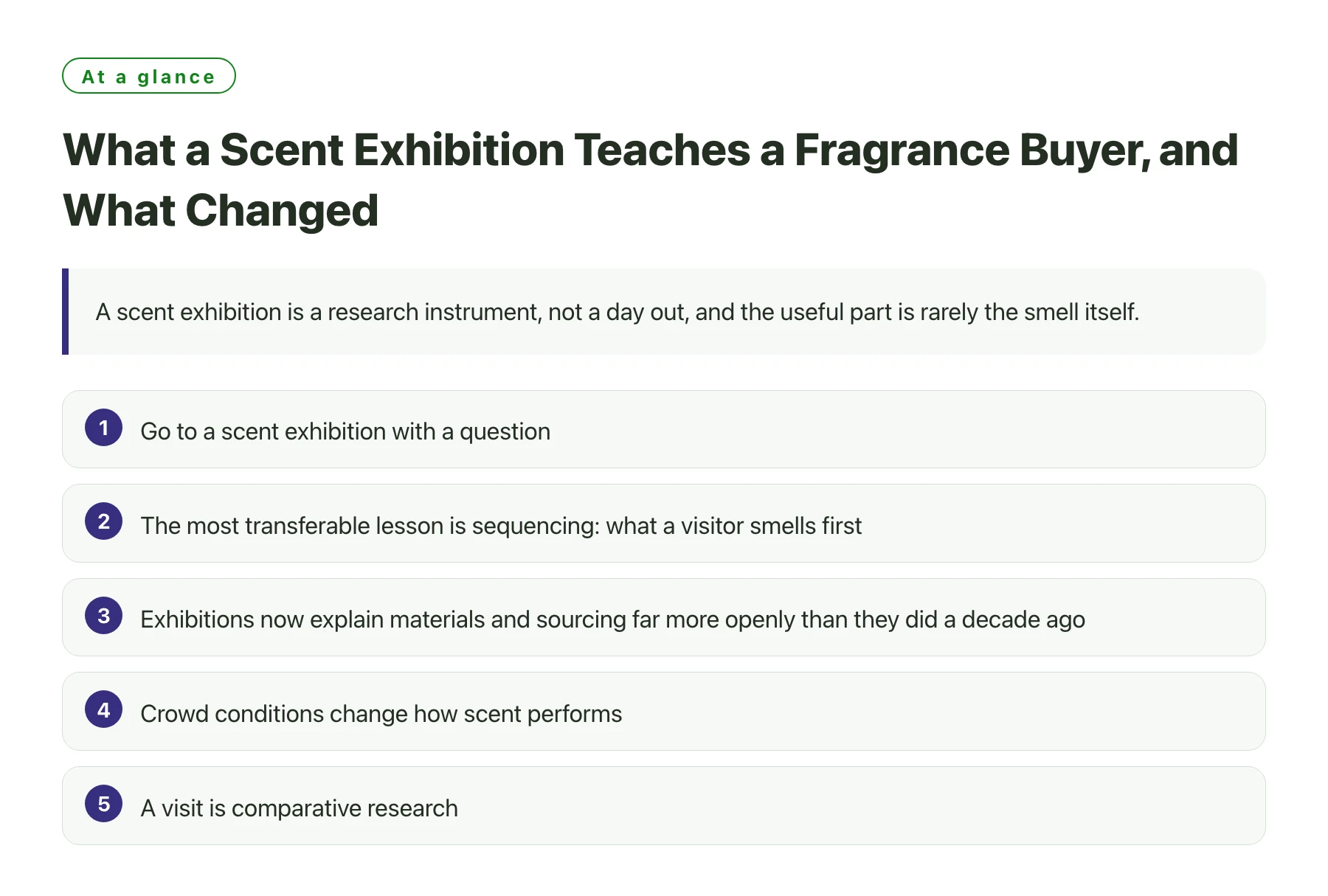
- Go to a scent exhibition with a question, because an unguided walk produces impressions rather than usable evidence.
- The most transferable lesson is sequencing: what a visitor smells first, second and last shapes what they remember.
- Exhibitions now explain materials and sourcing far more openly than they did a decade ago, which makes them useful for briefing language.
- Crowd conditions change how scent performs, so a fragrance that seems strong in a quiet room may vanish in a busy one.
- A visit is comparative research, not a supplier audit, and it should be recorded in the same way as any other site visit.
Fragrance buyers are sent to scent exhibitions for many reasons, and most of those reasons are too vague to produce anything. The visitor walks through, smells twenty things, takes a photograph of a wall text, and comes back with the observation that it was interesting. Nothing enters the brief, and the visit is written off as a pleasant afternoon.
That outcome is avoidable. Exhibitions are built by people who have to solve real problems of attention, humidity, footfall and narrative, and those problems are close cousins of the ones a brand faces in a shop or a launch. The notes below are written for a niche house that wants to convert an exhibition visit into decisions about its own range.
What an exhibition is actually good at showing you
The first thing an exhibition can teach is raw material character. Most visitors meet a material as part of a finished composition, where it is one voice among many. An exhibition that presents materials more or less in isolation gives a buyer a reference library in the head: this is what a rose base smells like on its own, this is how much of a wood it takes to hold a top note down. That vocabulary is what makes a later brief specific instead of descriptive.
The second is sequencing. Exhibitions are arranged, and the arrangement is a hypothesis about attention. Walk through one and notice where you slowed down, where you skipped, and where the scent had faded before the text ended. Those are the same questions a brand asks when it sends a sample kit or builds a shelf. Anybody who has spent a day watching visitors drift past the third room has learned something about how many scents a person will genuinely engage with in an hour.
The third is storytelling around smell, which is harder than it looks. A label, a photograph and a paragraph have to carry a scent that the visitor may not be able to name. This is the craft that sits behind professional scent training and behind every brand that has to explain a fragrance on a product page, and an exhibition is one of the few places where you can watch it succeed or fail in public.
A niche house should also notice what the exhibition does not do. It does not tell you whether a material is affordable at your volume, whether it is restricted in your market, or whether your factory can buy it. Those questions belong to a supplier conversation, and what niche fragrance brands need from a factory is a more honest starting point for them than an afternoon among display cases.
What changed in scent exhibitions over the last decade
| Dimension | Roughly a decade ago | What a buyer sees now |
|---|---|---|
| Explanation of materials | Names on a label, occasional botanical illustration, little sourcing context. | Material stories beside the scent, with origin, processing and the reason a perfumer reaches for it. |
| Delivery method | Blotters at a counter and a docent who controlled the pace. | Controlled air, individual delivery points and timed release, so a visitor can smell at their own pace. |
| Narrative framing | Objects first, with smell used to illustrate a period or a place. | Smell first, with objects and text arranged to support what the nose has already been told. |
| Commercial honesty | Brands largely absent or discreetly credited. | Brands named openly, including the manufacturing side that produces what is on the shelf. |
| Visitor expectations | Novelty, and a tolerance for exhibits that did not smell of much. | Comparison, with visitors arriving having read about the materials before they walk in. |
The direction of travel is toward interpretation that explains rather than impresses. That is consistent with how museums generally have moved, away from a single authoritative voice and toward context, uncertainty and provenance [1]. For a buyer it means the labels are worth reading as sources, not just as decoration.
How to run the visit like fieldwork
Before you go
Write down two questions you want answered, in the plainest language you can manage. Something like: how much rose does a room need before it reads as rose, or how quickly does a citrus top note disappear in a warm space. Exhibitions reward specific questions because they give you a controlled environment to compare against.
Check the practical details first. Opening arrangements, whether the space is being reinstalled, and how long a visit is meant to take are all published in advance, and a show mid-change teaches nothing. Visit the website before you plan a half-day around it.
Finally, book with a colleague who has a different job from yours. A product developer and a retail buyer will notice different things in the same room, and the disagreement afterwards is more valuable than either set of notes.
During and after the visit
Smell in a fixed order and log it. Which material first, how many minutes apart, and whether you were still able to describe it by the twentieth. Most people find their vocabulary collapses before their nose does, and knowing where that point sits is practical information for a sample round.
Note the conditions as carefully as the scents. Room temperature, humidity, crowd density and how recently you ate all move perception, and a museum that publishes or manages those variables is worth studying for that reason alone. The profession has spent a long time arguing about how much interpretation a visitor needs and how much smell can carry on its own, and the argument is unresolved [2].
Archive the notes the same week, in the form you would use for a supplier visit: date, purpose, what you smelled, what you concluded, what it changes in the brief. Oral traditions and craft knowledge are exactly the kind of heritage that cultural institutions now try to record rather than assume [3], and a brand's own scent references deserve the same treatment.
If the exhibition belongs to a manufacturer, treat the visit as a supplier signal rather than a museum trip. What the company chooses to explain about materials, sourcing and production tells you more about how it works than the size of the display does.
Sources
- ICOM — International Council of Museums —— The international organisation representing museums; publishes the ICOM museum definition and professional standards for museum practice.
- Museums Association —— A professional body for museums, publishing guidance and research on museum practice and visitor experience.
- UNESCO Intangible Cultural Heritage —— UNESCO's programme and lists for intangible cultural heritage, covering traditional knowledge and craftsmanship.
Frequently asked questions
Is a scent exhibition worth a day for a small fragrance brand?
Yes, if you arrive with two specific questions. Without a question the visit produces impressions that never reach the brief, which is the usual reason brands conclude that exhibitions are not useful.
What should I write down during a scent exhibition?
The order you smelled things in, where your vocabulary gave out, how crowded and warm the space was, and any label text that explained a material well enough for you to reuse the wording.
Can an exhibition teach me what a material costs?
No. Cost depends on grade, volume, harvest and the supplier relationship, and an exhibition will not price any of that. Cost belongs in a factory conversation with real numbers attached.
Why do exhibitions now explain sourcing more openly?
Visitors arrive better informed and ask harder questions, and institutions have generally moved toward showing provenance and interpretation rather than presenting a single settled account.
How many scents can a visitor genuinely evaluate in one visit?
Fewer than most people expect. Concentration usually degrades well before the twentieth material, which is a useful reminder when you plan how many samples to put in front of a buyer.